The idea for this approach to our students came from a teacher on TWITTER, where else? In the tweet the teacher wrote how he uses the video embedded here to show how the relationship between the five stages of grief can be used to show how teachers go through each stage when faced with professional development. It struck me how accurate the guy was in his perception of the (unfairly)dreaded training paradigm we are all faced with.
After giving some presentations around Turkey of the model, and receiving very positive feedback from audiences of teachers, I realized that the five stages could also be used to describe how students react to learning English. Several of my teenage students were displaying traits of Denial and Anger, Bargaining and Depression. So, I wanted to share this with them and went about making several lessons based around the model. The reaction to it really surprised me as students reflected on their own feelings. Now renamed, The FIVE STAGES of LEARNING, it was clear that patterns were emerging.
The responses here are so typical of many, if not most, teenage Turkish L2 learners. I don't know if it is because they have had teachers in the past that have turned them off learning the language, or its more of a natural feeling towards an education system that demands they learn a second mother-tongue if they are to go most universities. In any case, the problem is there, and we, teachers and parents, have to try and convince the students of the benefits to them if they get past this stage.
Inevitably, stage one and stage two work hand-in-hand. I propose that it is because of these two stages that cause the vast majority of discipline issues for high school teachers. If teachers reflect on the kids most likely to disrupt, contest and reject the lessons, I believe it is because of how the emotions these two stages manifest in the disruptive and problematic students.
This stage is common amongst all of the students at some point. It is natural for teenagers to try and avoid doing the extra work. However, I think in the context of the 5-Stages it is slightly different. I see the students who display these traits are actually trying to succeed. They just can't admit to themselves yet. They won't until they start to fail regularly, and the penultimate stage kicks in.
It is this stage that most concern for the student is felt by teachers, parents and friends. Unfortunately, it is not a quick stage to pass, as it often relies on results or success. If the student has been through the previous three stages, then his/her chances of passing or making progress are slim. Only after this has passed, the emotional heartache felt and that light bulb has turned on, will the 'victim' feel different. Teachers, parents and friends need to be very supportive and positive at this stage.
This is a fabulous stage to observe in your students. When they finally realize the error of their ways and start to make a difference in their learning curve. The smiles and positive energy that can be achieved here is unmatchable. A wonderful example from my own class last year saw a girl from out of town who moved to the big city under a sports scholarship. She was in denial and the other three stages back and forth for four months. We couldn't get through to her properly. She would promise that she had seen the light; but it would last but a few days, and then she be introverted and shy. It was only when she returned home and spoke to her old English teacher, who told her she had made brilliant progress in English from when she had left, that the girl felt worthy again. She instantly regained her self confidence. She came back to Istanbul and the change was extraordinary. She went from an average of 1.1 in the CEFR to a 3.1 in a month! It was extraordinary to see, and be a part of.
The case for self-belief was so evident that it not only made me believe totally in this model, but also in the hope for all students. If we can identify the stage that a student is at, we can go some way to helping them help themselves. If they can get over themselves and make the proper choices, they can really stand more of a chance for success.
Our Educational Message
Hi, and welcome to our blog. This space is designed to share ideas and methodologies that we use to teach Turkish teenagers. In particular, there is a strong focus on ICT-ELT, which means if you like visual and technological support for your style of teaching, this blog is for you. My colleague, Brentson Ramsey, has been working alongside me for three years. He is also a big proponent of the ICT-ELT Paradigm, which means he will also be posting from his own teaching perspective on the blog.
2010 was the beginning of this new journey, and although there is no definitive ICT-ELT road map available for everyone to follow, it is exciting to explore the technological means to make teaching more fun and affective for students. Our main message is for teachers to ADOPT & ADAPT the paradigm shift for their own needs, and remember that ICT-ELT is a TOOL, NOT a SOLUTION.
Sunday, 12 August 2012
Friday, 10 August 2012
BUILDING the CLASS ENVIRONMENT: Teacher Companion part I
This post is a continuation of the series started on the 9th, September. The reason for sharing the ideas and observations, theories and practices on this blog is in response to writing a teacher-companion that I started in 2011 with the collaboration of my colleague, Brentson. We both feel that putting our chapters up as blog posts can be a better way to reach a teaching audience quickly. The original form of the chapters has been changed to suit the formatting associated with blogs. We hope you enjoy them.
Student-Teacher Relationships
When you look at this image do you get that sinking feeling of a memory of your time back at school? I know that I do. I grew in the north east of Scotland during the seventies. It was rough back then and I cannot remember any day where at least one teacher adopted this type of communication with my class of very terrified peers. Therefore, its ironic inclusion here is simply a freminder of what we don't want as a model for our classroom environments. In my prep. class (Turkish word: Hazirlik) students are a different breed of teenage-learner. These students, for the most part, come to the preparation year with a lot of baggage that has accumulated throughout their middle school years. Although much of what they bring to the student-table might be construed as negative, we believe this is merely a wrongly focused perception by teachers, administrators and parental stakeholders.
These students, once they are shown what they have to do in order to succeed, transform into well- rounded and very successful students. This grade level, between 8 and 9, proves that no student need ever be left behind, if the correct, proper and formulated framework for success is in place. It is necessary, however, that dynamic teachers promote a positive mind-set and work within the boundaries of a well-organized and engaging syllabus, if it is to be successful. The first steps required before any syllabus expectations can be shared with the new intake of students is to introduce boundaries; in other words, a working framework where students and teachers can keep focused from lesson-to-lesson, week-to-week and semester-to-semester. This initial move by the teachers will go a long way to making the students settle down into the syllabus responsibilities quickly, relaxed and feeling comfortable enough to put trust in their teachers; thus forging positive relationships. What should this framework look like?
Class Rules where the teacher lays out the basic principles of: No shouting; No answering of questions without waiting to be asked; No excessive movement in and out of chairs; No throwing of any projectiles; No hot or greasy food to be eaten in class, even at break; These FIVE primary principles make the environment one for learning. It builds respect for the space of others, and clarifies the boundaries of right and wrong. Punctuality is to be adhered to at all times without exception.
It is very important that late students get recorded, no matter how late, in a class 'punctuality' notebook kept close by the door. If and when students arrive late they are not allowed to disrupt the class; instead, they write down their name, the reason for lateness and sign their name. While the infraction is being recorded by the student, the teacher carries on with the lesson. Since everyone is told about this from day one, students do ignore any latecomers and their attempts to disrupt their learning. In fact you soon understand that the others begin to resent such occurrences if you make it clear that you understand why any student is late. After class, the guilty students are spoken to by the teacher, in order to find the causes for the late arrival.
The book totally works at changing students attitude to time management. It takes a month of possible opposition and possible confrontation, but once they get used to it, and they see you are serious, the students soon stop coming late to class.Infraction Notices are to be administered throughout the first two months with a strong sense of discipline and purpose.
The notices are made from white, yellow and red. Thus, the way for infraction control is based on a tiered system, similar to a football game and the power that the referee has. A white card would be like a verbal warning to a player. It is important that verbal confrontation is not entered into, so as to keep the flow of the lesson and positive atmosphere in the classroom. The student is presented with the card and asked to write it up. As the student mulls over the infraction committed, s/he knows that a discussion about 'why' it happened will take place post lesson.
If the white 'warning' infraction card fails to pacify the student, a yellow is presented, and then a red. A yellow or a red card can be given immediately should the infraction be serious enough to do so. Infractions such as cursing, dissent or fighting with peers would be examples of such misdemeanors. At the showing of a red card, whether it be immediately, or as part of a chain, the student is then sent directly to the coordinator to explain the reasons, and then put on report for ten days. The student is monitored closely by both the teacher and the coordinator, which hopefully will put an end to the bad behavior. Laminated Pictures of quirky phrases and expected class rules should be on display in the class. By having the expectations, for instance: "No Whining", constantly on display the teacher can simply point to the wall without uttering a word or command, and the students have it always in their sights when their eyes drift from the board. It becomes part of the " getting used to the
system" that young teens need most of all. Anything that goes against their normal day to day expectations will always have immediate negative and contrary reactions. It's in their nature to show off, and make their point. So, by understanding and respecting what they need, will do a great deal to build bridges and garner respect.24/7
Available Contact via sms, bbm, email, PLN, LMS is made between the teacher and the students. This is something that many teachers would never consider, but it must be made clear that this very simple communicative tool can build the most trust for those students who find it difficult to make face-to-face contact with peers and/or teachers. However, a note of strong caution. It is vital that guidelines are set down from day one outlining the service, and how great it, but that it will not be operative if a violation of the guidelines happens. Students must know very clearly that any messages to teachers can only be about class work and assignments. That messages should be in language appropriate to the classroom atmosphere. Reasonable consideration for responses and feedback via this service must be taken into account when communicating with teachers. Teachers will check their messages and those on the class LMS daily, so a message will be forthcoming in a short period of time, if not, immediately. A Sense of Humor is essential in the classroom. Teachers need to be able to laugh at themselves. To give and take, and not do everything too seriously; otherwise students switch off, and engagement of the whole class is nigh on impossible.
It is also totally valid to consider light sarcasm, irony and leg-pulling as part of the dynamic. If you can build a to and fro jokey atmosphere with no malicious aforethought, then this approach to communication is valid. For many years teachers have written and claimed it has negative outcomes. This is tarring all situations with the same brush. There is a place for it provided teacher-control is adhered to. Any infringements need to be dealt with quickly and assertively. If this is done, then you will find great rapport with your students.
When you look at this image do you get that sinking feeling of a memory of your time back at school? I know that I do. I grew in the north east of Scotland during the seventies. It was rough back then and I cannot remember any day where at least one teacher adopted this type of communication with my class of very terrified peers. Therefore, its ironic inclusion here is simply a freminder of what we don't want as a model for our classroom environments. In my prep. class (Turkish word: Hazirlik) students are a different breed of teenage-learner. These students, for the most part, come to the preparation year with a lot of baggage that has accumulated throughout their middle school years. Although much of what they bring to the student-table might be construed as negative, we believe this is merely a wrongly focused perception by teachers, administrators and parental stakeholders.
These students, once they are shown what they have to do in order to succeed, transform into well- rounded and very successful students. This grade level, between 8 and 9, proves that no student need ever be left behind, if the correct, proper and formulated framework for success is in place. It is necessary, however, that dynamic teachers promote a positive mind-set and work within the boundaries of a well-organized and engaging syllabus, if it is to be successful. The first steps required before any syllabus expectations can be shared with the new intake of students is to introduce boundaries; in other words, a working framework where students and teachers can keep focused from lesson-to-lesson, week-to-week and semester-to-semester. This initial move by the teachers will go a long way to making the students settle down into the syllabus responsibilities quickly, relaxed and feeling comfortable enough to put trust in their teachers; thus forging positive relationships. What should this framework look like?
Class Rules where the teacher lays out the basic principles of: No shouting; No answering of questions without waiting to be asked; No excessive movement in and out of chairs; No throwing of any projectiles; No hot or greasy food to be eaten in class, even at break; These FIVE primary principles make the environment one for learning. It builds respect for the space of others, and clarifies the boundaries of right and wrong. Punctuality is to be adhered to at all times without exception.
It is very important that late students get recorded, no matter how late, in a class 'punctuality' notebook kept close by the door. If and when students arrive late they are not allowed to disrupt the class; instead, they write down their name, the reason for lateness and sign their name. While the infraction is being recorded by the student, the teacher carries on with the lesson. Since everyone is told about this from day one, students do ignore any latecomers and their attempts to disrupt their learning. In fact you soon understand that the others begin to resent such occurrences if you make it clear that you understand why any student is late. After class, the guilty students are spoken to by the teacher, in order to find the causes for the late arrival.
The book totally works at changing students attitude to time management. It takes a month of possible opposition and possible confrontation, but once they get used to it, and they see you are serious, the students soon stop coming late to class.Infraction Notices are to be administered throughout the first two months with a strong sense of discipline and purpose.
The notices are made from white, yellow and red. Thus, the way for infraction control is based on a tiered system, similar to a football game and the power that the referee has. A white card would be like a verbal warning to a player. It is important that verbal confrontation is not entered into, so as to keep the flow of the lesson and positive atmosphere in the classroom. The student is presented with the card and asked to write it up. As the student mulls over the infraction committed, s/he knows that a discussion about 'why' it happened will take place post lesson.
If the white 'warning' infraction card fails to pacify the student, a yellow is presented, and then a red. A yellow or a red card can be given immediately should the infraction be serious enough to do so. Infractions such as cursing, dissent or fighting with peers would be examples of such misdemeanors. At the showing of a red card, whether it be immediately, or as part of a chain, the student is then sent directly to the coordinator to explain the reasons, and then put on report for ten days. The student is monitored closely by both the teacher and the coordinator, which hopefully will put an end to the bad behavior. Laminated Pictures of quirky phrases and expected class rules should be on display in the class. By having the expectations, for instance: "No Whining", constantly on display the teacher can simply point to the wall without uttering a word or command, and the students have it always in their sights when their eyes drift from the board. It becomes part of the " getting used to the
system" that young teens need most of all. Anything that goes against their normal day to day expectations will always have immediate negative and contrary reactions. It's in their nature to show off, and make their point. So, by understanding and respecting what they need, will do a great deal to build bridges and garner respect.24/7
Available Contact via sms, bbm, email, PLN, LMS is made between the teacher and the students. This is something that many teachers would never consider, but it must be made clear that this very simple communicative tool can build the most trust for those students who find it difficult to make face-to-face contact with peers and/or teachers. However, a note of strong caution. It is vital that guidelines are set down from day one outlining the service, and how great it, but that it will not be operative if a violation of the guidelines happens. Students must know very clearly that any messages to teachers can only be about class work and assignments. That messages should be in language appropriate to the classroom atmosphere. Reasonable consideration for responses and feedback via this service must be taken into account when communicating with teachers. Teachers will check their messages and those on the class LMS daily, so a message will be forthcoming in a short period of time, if not, immediately. A Sense of Humor is essential in the classroom. Teachers need to be able to laugh at themselves. To give and take, and not do everything too seriously; otherwise students switch off, and engagement of the whole class is nigh on impossible.
It is also totally valid to consider light sarcasm, irony and leg-pulling as part of the dynamic. If you can build a to and fro jokey atmosphere with no malicious aforethought, then this approach to communication is valid. For many years teachers have written and claimed it has negative outcomes. This is tarring all situations with the same brush. There is a place for it provided teacher-control is adhered to. Any infringements need to be dealt with quickly and assertively. If this is done, then you will find great rapport with your students.
Thursday, 9 August 2012
Understanding by Design of our ICT-ELT Syllabus
As mentioned in my last post on setting up the pilot project for my Hazirlik, I found the first year extremely demanding, yet fabulously rewarding in both personal growth and as a teacher of technology in an English classroom. This post is aimed at focusing on how the syllabus has been transformed from a typical Hazirlik ELT learning platform with some ICT included, and into a full-on ICT-ELT focused curriculum that is current, progressive and demanding across several levels of English and ICT learning outcomes for the students.
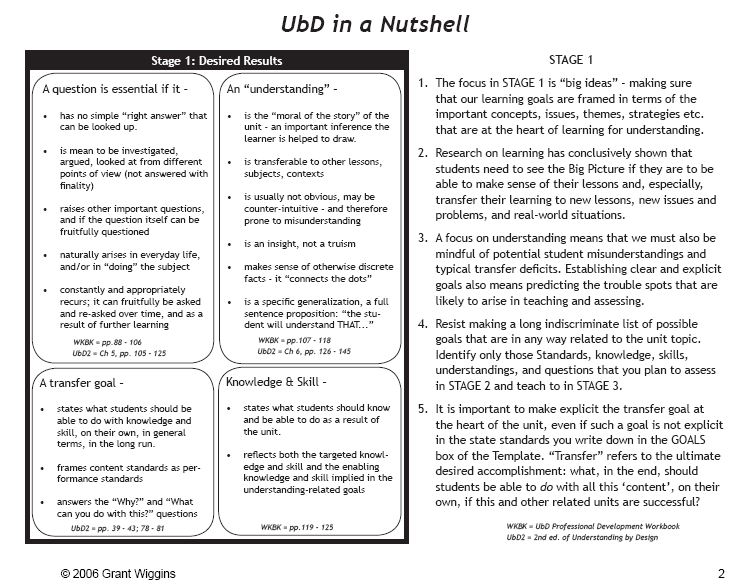
I believe a good starting point for this is to share with you my feelings on UbD. The pictures of ubD in a nutshell from its author Grant Wiggins is the best way to look at what it aims to do with a curriculum. I can then express how we approached it and give an example of one of our templates in response to Wiggin's awesome curriculum template model.
In this first image you can see how Wiggins stresses that the main aim is for students to understand from quality transference of knowledge and information through a clear, precise and well-thought out objectives, outcomes and enduring understandings. This was something that I had seen in my years of curriculum design, however the simplicity of the template and clarity of the message therein made everything so clear for us in Hazirlik.
In this section of the template the focus is on the Big Picture of the unit. In order for us to develop quality understandings for the students we had to prepare Essential Questions which basically are the springboard to success of every unit taught. We believed that by conjuring up and preparing these classroom questions, which we had posted on the wall every Monday for the week, meant students had a focus on what they would be taught and what they needed to be able to answer come Friday. This is one area where were able to include ICT in the facilitation of the EQs (Essential Questions). We put the EQs into our flash card application and the students have to choose one EQ that they will answer over the weekend by posting their response to that EQ on . This is the first proper culmination and joint ICT-ELT collaboration.
This section deals with assessment of the content therein the unit. This was where we realised that not only could we use normal summative assessments from completed units, but that since the depth of content we prepared for each unit was substantial, and the time we spend with the students extensive, the opportunity for formatively assessed activities, assignments and day-to-day progress could be observed. This further strengthened the need for teachers to adopt the formative model of assessment as it gives a better and more balanced outcome for all students. Nobody, is literally ever left behind. There is no chance for escape or to slip through the net with a false-ceiling ability often seen in summative test results
This final part of the UbD template series highlights very cleverly the W.H.E.R.E.T.O. acronym. By teachers thinking about the direction where and how their unit is going, by which activities they can include so that their students benefit from means each unit goes full circle in the critical thought processes. Not only does UbD encourage students to think outside the proverbial box, but also it expects teachers to know their syllabuses inside out. one marvellous quote I heard while taking training in UbD was this: "UbD is not about covering the syllabus, it is about UNCOVERING the syllabus." I thought that was awesome and it sticks with me always when I prepare a unit.
We knew after year one tha the Haırlık program had to be improved so that we could incorporate language, literature and ICT with a strong focus on skills that would take students to a level that would allow them some comfort in understanding and using English in grade 9.
Below you can see an example of the language UbD template that we complete prior to our 2011-2012 start. Remember we had no idea of how or whether this would work.
These three images of our unit one on language in use is clearly focused strongly on ELT in traditional terms. We do believe in the use and identification of the meta terms in ELT. If students are able to decide when to use simple tenses over continuous tenses this is a big step in making English work for them. It is not part pf the acquisition model we know, and that is why we believe in it. Turkish students who are faced with intense L2 and need to get through it successfully and quickly, need to have ways available to them, so they can believe in their own learning and take responsibility for it. Not all students welcome the meta-terms, but have them there in case they should need them. Examples of those students are the ones who already grasp the grammar time-frame. They genuinely find it difficult to grasp meta-language, like most native speakers, and that is okay also. In those cases we make sure those students are not at a disadvantage. They are expected to grasp the sections of language with numerous examples of contextualized sentence and paragraph building.
In section three you can see the inclusion of ICT elements that help to engage and interest students more. This is where we started to move away from traditional methods and activities. The internet became a very large part of our syllabus.
To sum up about UbD, we embrace the whole concept. I have yet to see anything that matches in terms of its simplicity, expectations for depth of content and overall expectations for students and learning outcomes. The uncovering of the syllabus as opposed to simply covering it really makes teachers critically think of their aims for content and objectives in a unit. For us, if we can teachers to think more about what they are doing and seeing the point of view from a student's perspective has to be an improvement for huge number of teachers. We hope that this blog post can inspire more teachers to look at UbD and how it could work for you.
Try to remember that you will provide a better service by never being satisfied with only covering the syllabus; go one step further to Uncover it and find the best ways to engage, transfer the knowledge and instruct quality pedagogical models.
Adopting and Adapting ICT for Your Own Road Map
Hi, I have to begin by saying how happy I am to be back in the blogosphere after a long rest from the rigors of weekly posting. It is an extremely cathartic practice to get frustrations off one's chest, and that will never change. However, I want to make my rejuvenated blog space as a positive outlet for myself and my colleague, Brentson Ramsey, to share what we are doing in our Hazirlik class. Each post will highlight a specific area of our program or practices and methodologies. We have much to share, so without further ado, I will begin by sharing reasons behind why I made the leap from traditional ELT teacher to ICT-ELT practitioner, tech-enthusiast and now a blogger-with-a-huge message: Adopt and Adapt.
My decision in 2010 to adapt ICT for ELT was part of a pilot scheme at my school. The administration wanted to find a new direction for Hazirlik (Turkish word for Preparatory school). For years, schools around Turkey have wanted to raise the level of English for high school students. The Hazirlik program is meant to cater to this demand for better English. It is a year group that has students enter with zero understanding of English, and has them exiting as a comfortable B2 level student in consideration of the CEFR.
However, the year group has become the dumping ground for empathetic students, students with learning or skills deficiencies and teachers who really don't care what happens. I am generalizing here, of course, and I do so only to give some sense of context and perspective. If you go to any school and ask language teachers if they would like to teach a prep. or Hazırlık English class, I am sure the response would be in the negative for almost everyone. That is why I had turned down the offer two years previously to work in Hazirlik. So, what changed my mind? The answer to that is because the school was going to inject money into the program so that we would have netbooks for the students to use in class at all times and a projector with IWB. I felt excited, rejuvenated in fact, because I had grown tired of literature classes with the seniors. I had grown too comfortable with students who were proficient in English.
I needed a change of direction. I wanted to teach language in an ELT context, and along came ICT-ELT, and I have not looked back once (well apart from negative reflections of what used to be.
TEETHING PROBLEMS: It was strange for me two years ago having all this technology at my disposal. The students were also taken aback and couldn't believe it. I remember one morning hearing some tenth graders walking past the class and commenting on how my class looked like an internet café. I smiled, but I couldn't help but think that the class, after a month, had been reduced to that perception. I reflected and realised they were right. I wasn't directing and leading it properly. I hadn't set up the ICT-experience for the students adequately. They had the impression that the netbooks were their opportunity to skip class activities, to flaunt the system, to get by without doing anything from 8-3.30 every day. I needed to change direction again. So, I announced that the netbooks would be removed and locked away until the students grasped the concept that the netbooks and ICT were being provided as support tools for their learning; not as some escape route for doing no lessons. I, therefore, brought out the netbooks for short intervals of twenty minutes maximum to cover writing, on-line grammar activities, posting on Edmodo and pppt instruction. This restricted environment led all the students to believe I was serious. They had this treatment for three weeks, so that the cycle of "only fun, no learning" could be turned around. They responded because they were being told that Learning CAN BE fun. They could now see that by using the netbooks as a tool for supporting their learning of English and for learning new skills, it was beneficial for them to conform. It worked.
The next seven months proved to me that my first year in ICT-ELT was completely different to what I had been used to as a language teacher. I now believed in IWB instruction, e-Learning, 24/support and students willingness to engage and participate in a Hazirlik program. However, I knew I had to make major changes to the ICT-syllabus if it was going to continue to grow with the advances in technology. I looked at ways to approach this huge task, and it was UbD (Understanding by Design) that would show me the light. This was the system of critical thinking for the syllabus that would now help me to ADAPT the newly ADOPTED ICT-ELT paradigm of which I was now a strong advocate. Bring it on 2011-2012 academic year!! My next post will describe how UbD worked for improvements to my 2010-2011 Hazirlik syllabus...
My decision in 2010 to adapt ICT for ELT was part of a pilot scheme at my school. The administration wanted to find a new direction for Hazirlik (Turkish word for Preparatory school). For years, schools around Turkey have wanted to raise the level of English for high school students. The Hazirlik program is meant to cater to this demand for better English. It is a year group that has students enter with zero understanding of English, and has them exiting as a comfortable B2 level student in consideration of the CEFR.
However, the year group has become the dumping ground for empathetic students, students with learning or skills deficiencies and teachers who really don't care what happens. I am generalizing here, of course, and I do so only to give some sense of context and perspective. If you go to any school and ask language teachers if they would like to teach a prep. or Hazırlık English class, I am sure the response would be in the negative for almost everyone. That is why I had turned down the offer two years previously to work in Hazirlik. So, what changed my mind? The answer to that is because the school was going to inject money into the program so that we would have netbooks for the students to use in class at all times and a projector with IWB. I felt excited, rejuvenated in fact, because I had grown tired of literature classes with the seniors. I had grown too comfortable with students who were proficient in English.
I needed a change of direction. I wanted to teach language in an ELT context, and along came ICT-ELT, and I have not looked back once (well apart from negative reflections of what used to be.
TEETHING PROBLEMS: It was strange for me two years ago having all this technology at my disposal. The students were also taken aback and couldn't believe it. I remember one morning hearing some tenth graders walking past the class and commenting on how my class looked like an internet café. I smiled, but I couldn't help but think that the class, after a month, had been reduced to that perception. I reflected and realised they were right. I wasn't directing and leading it properly. I hadn't set up the ICT-experience for the students adequately. They had the impression that the netbooks were their opportunity to skip class activities, to flaunt the system, to get by without doing anything from 8-3.30 every day. I needed to change direction again. So, I announced that the netbooks would be removed and locked away until the students grasped the concept that the netbooks and ICT were being provided as support tools for their learning; not as some escape route for doing no lessons. I, therefore, brought out the netbooks for short intervals of twenty minutes maximum to cover writing, on-line grammar activities, posting on Edmodo and pppt instruction. This restricted environment led all the students to believe I was serious. They had this treatment for three weeks, so that the cycle of "only fun, no learning" could be turned around. They responded because they were being told that Learning CAN BE fun. They could now see that by using the netbooks as a tool for supporting their learning of English and for learning new skills, it was beneficial for them to conform. It worked.
The next seven months proved to me that my first year in ICT-ELT was completely different to what I had been used to as a language teacher. I now believed in IWB instruction, e-Learning, 24/support and students willingness to engage and participate in a Hazirlik program. However, I knew I had to make major changes to the ICT-syllabus if it was going to continue to grow with the advances in technology. I looked at ways to approach this huge task, and it was UbD (Understanding by Design) that would show me the light. This was the system of critical thinking for the syllabus that would now help me to ADAPT the newly ADOPTED ICT-ELT paradigm of which I was now a strong advocate. Bring it on 2011-2012 academic year!! My next post will describe how UbD worked for improvements to my 2010-2011 Hazirlik syllabus...
Thursday, 3 November 2011
Engaging students in EDMODO
Engaging students must surely be the most talked about subject in ELT these days. Everywhere I go and there are teachers around, I hear complaints of how students won't get involved, that they couldn't care less and that standards are dropping. This, does seem to be the case and it is all very sad. However, one little flicker of hope has been lit in my class, and it involves this marvellous platform, the internet, and in my opinion, the best LMS/PLN site currently on the web 2.0. May I introduce you to EDMODO . I have been using this every day this year and I am now starting to see the effect on the students and their engagement with the course. It is not 100% of the students, but out of 22 I can safely claim that 18 use it daily and interact, with the other 4 opening the site for important information. I have made three videos below that explain what it looks like, how it works and for the me the best video is where I show the students interacting and engaging in the course materials and sharing ideas and helping one another ALL IN ENGLISH. There isn't a Turkish word in sight and this must surely be a first! for a Hazırlık class. So, no more waffling, here are the videos, and I hope they can encourage you to try it out</object>
warmly, affectionately and edmodo.comly
DavidM
Wednesday, 19 October 2011
Six Weeks is NOT a Long Time for Sts to Learn...BUT it IS time enough for us
This week's post concerns the skill of close reading and the students' ability to think more for their own understanding. In fact, it boils down to an Understanding-to-Understand concept that is something we as adults probably take for granted, since we now most probably do understand most things that affect us both positively and negatively (well at least if you have been around for almost a half-century!). It reminds of UP and how the old man takes for granted his own knowledge, until he is shown there are other ways to look at the world. I believe that today saw my colleague and I have a moment of clarity that took the inability of our students to fully grasp concepts for reading that seem like second-nature to us as teachers and adults.
The StudentsWe teach students who have managed, over the period of eight years or, in most cases, less to reach good levels of pass grades in subjects other than English. Hence the reason that they have to complete one full year of English education covering the language itself, maths and science. It means they are in the fortunate position of expanding their lexical and grammatical base to high proficiency levels before they enter high school, where all the education is taught in English. It thereby goes that we have a really diverse demographic, which causes a strong dynamic, thus making the job very interesting, and, dare I say it, exciting!?!
One of the areas that we need and like to focus on is that of close-reading skills. It is imperative that our students reach a reasonably proficient level of reading in L2 if they are to have any hope of success in high school. So, after the initial three weeks of general English lessons (60 periods) we start on the focusing of skills in reading. For this we use L2 readers. Now, before I start my exposition, I don't want to open up the debate of reader v original novel at this time. Just for those out there who may think we may not have authenticity in our skills program in terms of literature, they can be rest assured that in the second semester we move into authentic L1 teenager novels, so that the students are, indeed, ready for the rigors of high school English-Lit. The reason for this, we firmly believe, is the accessibility of the texts at this age and level, which should allow the students to at least feel they are having the opportunity to read prose in English. We have chosen stories especially written for L2, and not abridged readers; so there is still some semblance of authenticity, in actual fact.
The Reader The book we started with is "David and the Great Detective". A simply written narrative of 53 small pages in length, interspersed with pictures in comic-book style exposition. It tells the story of a down-trodden and bullied boy who lives his life in a dream world as the great detective in the title, in order to escape his troubled life at school. He is a loner and is often teased and bullied as a result. These themes are excellent for young teenagers to address and respond to with the simple level of their language skills. The protagonist is called upon to show his brave and empathetic side in order to save his soon-to-be former antagonist from a gang of bicycle thieves. Just to add some spice and colour to the piece, David's female class peers also come to the rescue and help David to save the day. The resultant climax is for David to realise that he is a hero and that his peers respect him for his bravery, resilience and detective skills used to overcome the bad guys.
The Methodology The idea for reading was to scaffold the text by splitting the 53 pages into three reading sections. These sections would be read in silence by the students for the initial comprehension. This was then followed by an activity where the students were put into groups of four and they had to prepare questions that the other two groups would attempt to answer. However, we never accepted any surface level or simple comprehension questions. Instead, they were encouraged to think outside the box, and to try and consider primarily "WHY" questions. This would hopefully mean more quality Q/A sessions post reading discussion-activity. Lo and Behold we got results. Each of the three sessions appeared to be highly successful, and we thought how great it would be to consolidate the title in its conclusion today by having the students complete the following activities: The students were to work in groups to Brainstorm for the 12 most important events in the story. REMEMBER they had already done this over the past two weeks in class with yes/no, right/wrong responses as groups and individuals. Both my colleague and thought we were set for a quality lesson. HOWEVER, THAT DID NOT HAPPEN!!!First of all, the students seemed to have forgotten what a brainstorm session was. After I cleared that up they got going. Next I saw that they were writing long sentences and asking if the grammar was right?!. I explained again that simple notes were fine for now. I wanted them to be thinking of the events and cross-themes in the story. After fifteen minutes I asked them to tell the class what their individual and group findings were. I was expecting really good returns for this activity. I mean we had previously done Blooms-styled questions; used UbD teaching expectations and objectives; given them plenty of scaffolding and encouragement to take risks with their questions and answers; we had allowed them silent reading time in class; we had prepared worksheets that required them to think as well as show their comprehension of the content, themes and events.THAT DID NOT HAPPEN!! In fact I was left with my jaw dropping on the floor as to what they were thinking in terms of important points; ie rising action events leading to a climax (as seen in the plot triangle- the follow-up activity that we never got round to) After this moment of madness, but not yet clarity, I asked for them to consider the climax for the story. They thought for a few minutes, and then I asked for their suggested answers...not one of the eleven students could come up with, or anywhere close to the climax. is of David's realization that he was a hero, people accepted him and that he was indeed a normal person: ACCEPTANCE & BRAVERY being the themesIt was extraordinary how they all seemed so confused, lost and incapable of rational thought. I met with my colleague for lunch and we came to the following conclusion.Conclusion and Follow up Action This was only the second example of the Plot Pyramid and Timeline concept that they have been a part of; In their previous schools, they have very rarely been asked anything other than surface level comprehension questions before for English lessons; They have probably never really been brought to task about their inability to explain what it is they actually know (or don't know) from any text- even if they had even read English readers at all; and more frightening is the realization, or possibility, on our part, that they have never been expected to do anything other than write down the teacher's answers to any questions, and then do cramming two hours before the exam.We have decided to do the activity again, and continue in the same train of thought. We realise that they are having so much English learning going on that something has had to give; namely, in this case, the ability to consider deeper, critical thought. We must be aware as teachers that we have only been together for only six weeks. They have been stuck in other ways and bad habits for over eight years! Our job is to try and break those bad habits. Habits like only waiting for others to take the risk, and then accept that they couldn't do it and give up. In practical terms we will also add an additional while-they-read log of whats happening in the timeline of the story. With this in place, just as with many SSR type expectation activities, our students should hopefully make them become more reflective and aware of what is actually going on in the story, and why.Jerry Springer Moment I feel it was a great learning-how-to-teach-it-better-the-next-time-moment, as did my colleague. Although I have over a decade more teaching experience, and nearly 20 years in age difference on him, I felt today that we were on a totally even keel for learning-thru-teaching in the trenches. What could we have done differently? we both asked each other. Well, we might have done more scaffoldng and had lower expectations. But as my young mate said to me at lunch, "it is something that will come with experience, right, David?" I can only say that with more than fifteen years in doing ELT, it just goes to show that we are all on a huge learning curve, and we should never forget that or become complacent about our practices. Finally, I want to share how much have enjoyed this day primarily for the reason that I do not know everything about teaching ESL, not even remotely. It is a wonderful feeling, through reflection, discussion and pro-active sharing with a colleague that I can continue to learn more each day about this challenging, yet worthwhile, profession and hopefully transfer better lessons to the students who are able, without even thinking about it, to make a difference to us as their teachers.
Wednesday, 12 October 2011
Getting Students to Write? easy with a Video-Penzu-Monday
The idea of getting students to write journals is nothing new in TESOL. AGREED! But what we have in our teaching toolbag is an innovative, quirky and enjoyable addition that I suggest every teacher, at least, tries out: No longer do we need to humph around 22 (or more) class journals to give some feedback for students' work and responses to various subjects, states of mind, activities or anything else that may be thought of as worthy of writing down. So, how do I do it, and what is it?
The suggestion is for teachers to offer their students the opportunity to respond via their smart phones, laptops, netbooks or ipads. Below is an example of how penzu returned me 22 responses from students who have numerous other homework activities, but this whole experience was controlled by the students themselves and the wonderful help of penzu.com
First of all, I assigned a student with the help of triptico.com
which is a desktop application that randomly chooses students for assignments, class groups and times them against the clock! Anywho, the student was asked to find a video of her choosing and to bring it in on Monday for her peers to watch and respond to. She was very excited that she had been given this responsibility, and as a result brought in two! However, I asked her to make the choice and she decided on the following video:
We watched the video twice to get the idea of themes that could be extrapolated by the students. I then set up the IWB to record their ideas. Below is what the class produced from the 1.39 video
You can see that from a group of not-quite-14-yet students the ideas are reasonably sophisticated. This is what excites me about video in the classroom. It springboards so many varied and wonderful ideas through brainstorms of this sort that it is hard for me to see any better way for classic skills to be tapped into and utilized. The task was then for the students to go home and write up their responses via penzu.com. However, the beauty of how the original idea has been tweaked is the ace up my sleeve. I asked the students to send their responses to Zeynep, the girl who found the video, who would then collate their efforts into one email and forward them to my class email address (hisarhazirlik@gmail.com). She was then given the option of whether to write or not since she would be doing all the secreterial work. This idea of "give and take" is of the utmost importance with teenagers. She jumped at the chance not to write this time, but I KNOW she will be willing to write so much the next time round when it is her friends' chance to choose the video.
So all 22 did the activity (11 to Zeynep's class, 11 to a student from the sister class) and sent them to her. She then did her secreterial job, and we looked at some of the responses on the Tuesday morning to see how people felt about the themes. Below is a selection of some entries
You can look ugly but that doesn't mean you are a ugly person in yourself. Trusting yourself and the people around yourself is the main way to accept the place you are in. If you just decided to go that way, you have to go without judging it because it isn't someone elses choice it's our own choice.
In the ad the couples that overcome their prejudice wins two Carlsberg beer and everybody congratulates them and the other thing that we can think in this ad is "be brave , you can do it" but , i think that the main idea is the "don't judge people from their appearances”.
We don't judge people by apparences.We should be respect for different people.We should trust ourself.We shouldn't be unsocial and shy.If we are biased to act we can make mistakes easily.
To judge people from their out look is a really bad thing because first you have to meet them and learn their personality. Maybe there is a very big guy and everyone is scared of him, dont be like that go and meet him if his personality is good than you can be friends or in an other way there can be a guy that is very good looking but in his inside he can be a really bad person. You can judge people from their out look but it would be your opiniont and I know a word about this dont judge a book from the title.
Some people judge others according to their appearance but some people's insides and outsides can be different. We musn't be biased.We must keep in our mind that everyone's equal. We musn't judge people according to their appearances.
So, although you can detect minor syntax and grammar issues within each entry, the quality of thoughts based on part or all of the brainstorm are clearly there. But, for me, the most important part of this activity is that students are so willing to respond tthrough writing for their English class.
Subscribe to:
Posts (Atom)